The grain of the wood changes the same laser line
Two discs cut from the same plank come out engraved differently, and the cause is written in the growth ring of the tree. Here is why it happens, what the production record bank shows, and what to ask for so the line bites clean, with no crater and no brown halo.
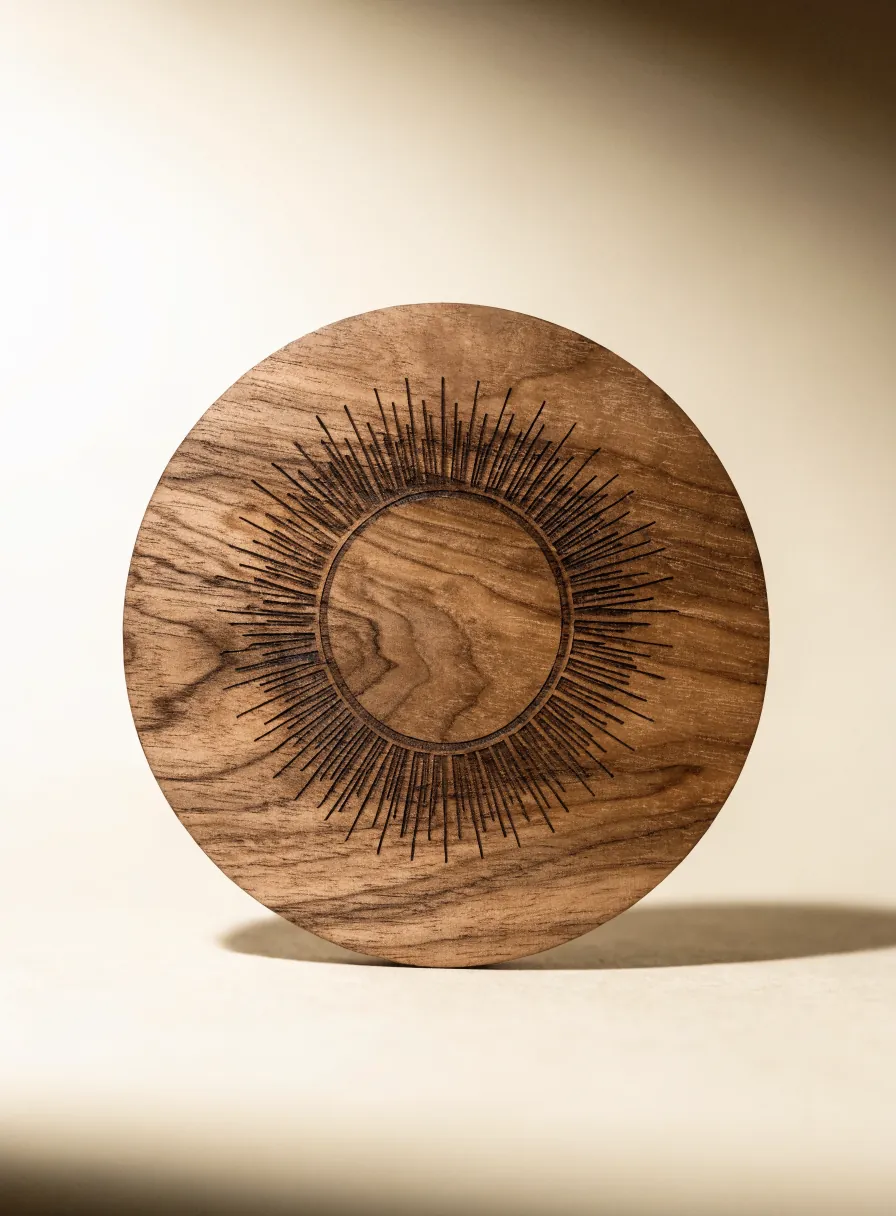
Every growth ring holds two woods, a porous springwood and a dense, heavy summerwood, and those alternating bands are what we call grain. At one power setting the laser sinks the groove deep in the porous band and leaves it shallow in the hard one, so an identical file yields two different pieces on two boards from the same plank.
A laser engraving travels as a file with an exact recipe, same vector, same power, same speed, same number of passes. Run that file on two boards and you will receive two different pieces. The whole difference lives in the wood. The beam burns a tiny point until the fiber goes off as smoke, and the depth of the groove follows the density that sat underneath.
Before going further, here is where each number comes from. The ones from the Atelier's production record bank are cited with their record and their routing step. The ones from the craft are given as craft. The bank holds 68 records where the technique is laser engraving and the material is wood. Of those 68, twenty name the grain in the field that records where the piece fails. That count is the reason for this entry.
One board holds two woods inside
The craft knows this and no record measures it. Every growth ring contains two woods. Springwood grows fast and comes out porous. Summerwood grows slowly and comes out dense and heavy. The two alternate along the board and form the light and dark bands we call grain.
At the same power setting, springwood gives up more material, the groove drops deep and the line opens. Summerwood holds, the groove stays shallow and the stroke comes out pale. A straight stroke crossing six bands comes out with six different widths, and that six is an example built to explain the effect. This is what you see when an engraving comes out streaked while the file is flawless.
Out of this comes a design decision that costs nothing, the orientation of the stroke. A line parallel to the grain stays inside a single band and comes out even from end to end. Turn it ninety degrees and it crosses band after band, and a long name set horizontally over vertical grain crosses them across every one of its letters. Turning the artwork is often enough.
Some woods spread their pores evenly
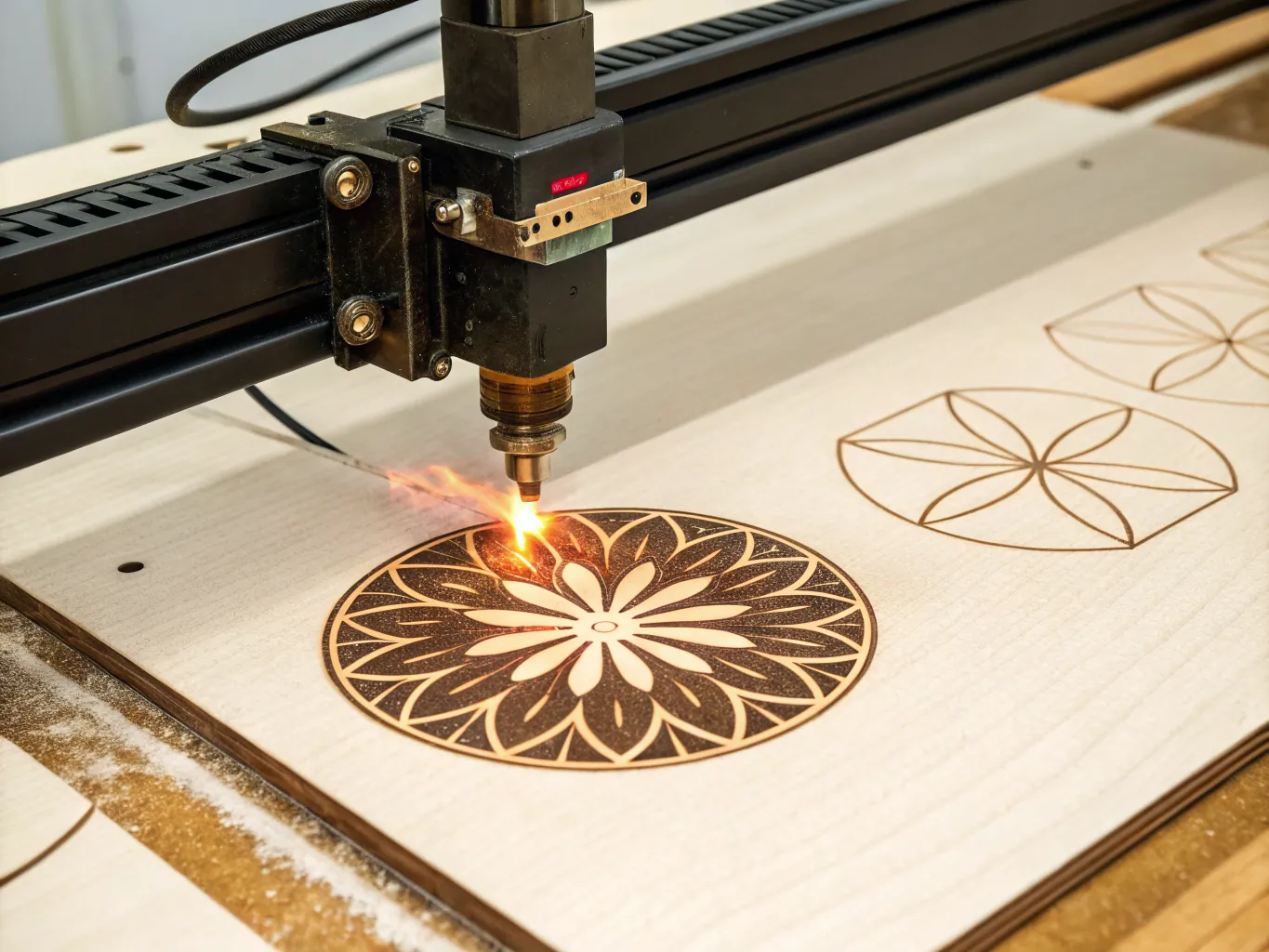
This classification is craft as well, and no record in the bank names ring porous or diffuse porous wood. Ring porous woods pack their large pores into a narrow strip at the start of every ring, and ash, oak and encino, the Mexican oak, belong there, with the grain strongly drawn and the laser giving it away on every stroke. Diffuse porous woods spread those pores across the whole ring, and maple, birch and linden belong there, with even density over the whole face.
Nogal, the walnut of Mexican fine carpentry, sits in the middle, with live grain and even density, and 41 of the 68 records name it in the material. When fine detail rules, you ask for diffuse porous wood. When visible grain rules, you ask for ring porous wood and you arrange the artwork so no thin line depends on crossing it. The Atelier's finishes begin with that question, which wood goes under the stroke.
Where the brown halo comes from
Fifteen of the 68 records name the halo or the overburn in the field that records where the piece fails. The halo is heat that was left over. When power rises to beat a hard band, the excess travels along the fiber and toasts the wood around the groove. What stays is a brown halo that went into the pore, past the reach of sanding.
The craft controls it three ways, and it helps to separate which ones are written down. The first is lowering power and running several passes, and that one is written down. The record for the engraved walnut disc calls for it in step three, so the line bites without opening a crater. The second is the air assist, a steady jet that pushes flame and smoke to one side. It sits in step three of the record for the pierced rosette, and it is the only one of the 68 records that names it. The third is masking the face with film or tape so the soot stays on the mask, and that way is technique knowledge and nothing more, because none of the 68 records logs it.
The test runs on an offcut of the same board
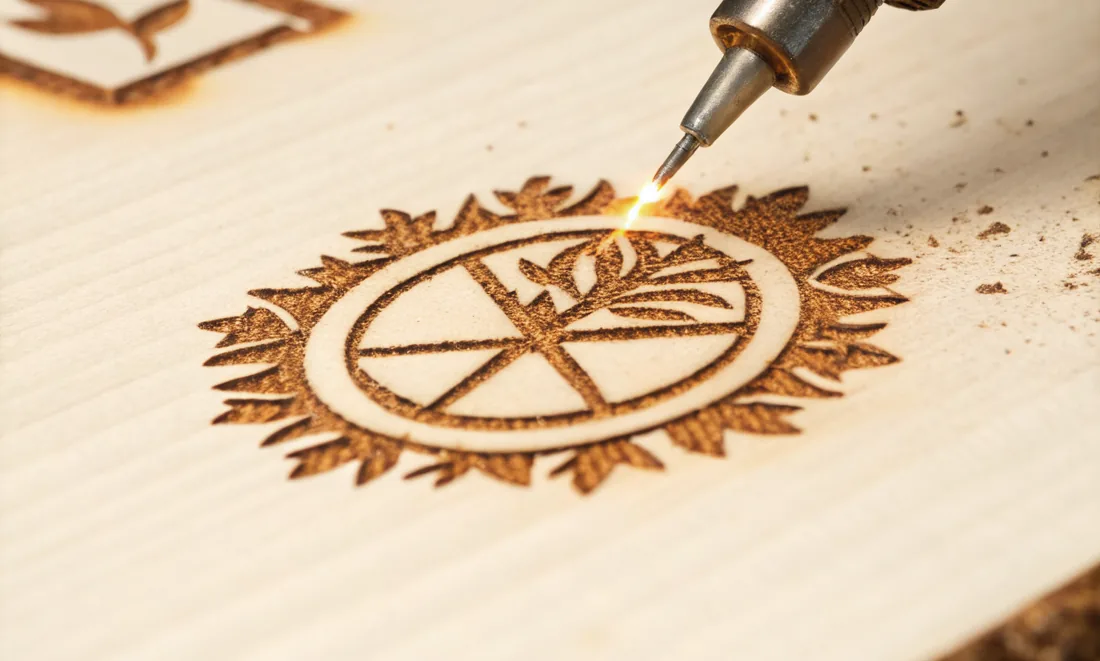
Every batch burns differently, by species, by moisture and by the sealer it arrived with. So the workshop runs a test grid of power and speed on an offcut of the same board, and the recipe for the run comes out of that. Two of the 68 records put it in writing, the one for the emblem on pale wood and the one for the rigid walnut card.
The final oil or wax soaks deeper into the engraved zone, where the fiber was left open, and the pattern darkens as it seals. So the grid is judged already oiled, and what you approve is what you will receive.
A cupped board changes its distance to the lens as the head advances, the focus drifts and the line moves with it. That is why the first step calls for gauge. Sixteen of the 68 routings name gauge, planing or thickness in that first step, with these values. A walnut disc is planed to 10 to 15 millimeters. A solid kiln dried board of walnut or parota, the wide tropical hardwood of western Mexico, arrives at 20 to 25 millimeters. A rigid walnut card is sliced at 3 or 4 millimeters. A card of ash veneer lives at 1 or 2 millimeters.
The smoked edge and the change of machine
CO2 laser cutting leaves the edge smoked with a soot that marks the hands, and it is sanded edge by edge by hand. Thickness decides which machine cuts, and the record for the pierced lattice writes it into step two. Once thickness passes 12 millimeters or the wood is solid, the cut goes to CNC router. The record for the rosette starts from 3 millimeter birch plywood, and the one for the tea box cuts body, lid and compartments in a single run on 4 and 6 millimeter birch plywood.
Counting the distinct workshops named in the routing of each record, the engraved walnut disc runs 5 steps and 4 workshops, fine carpentry that planes, CNC router that cuts, laser engraving that burns, carpentry again for the soot and the oil, and packing. The pierced lattice runs 4 steps and 2 workshops, fine carpentry and CO2 laser cutting. The piece arrives even because someone decided which workshop takes each thing.
What to ask for
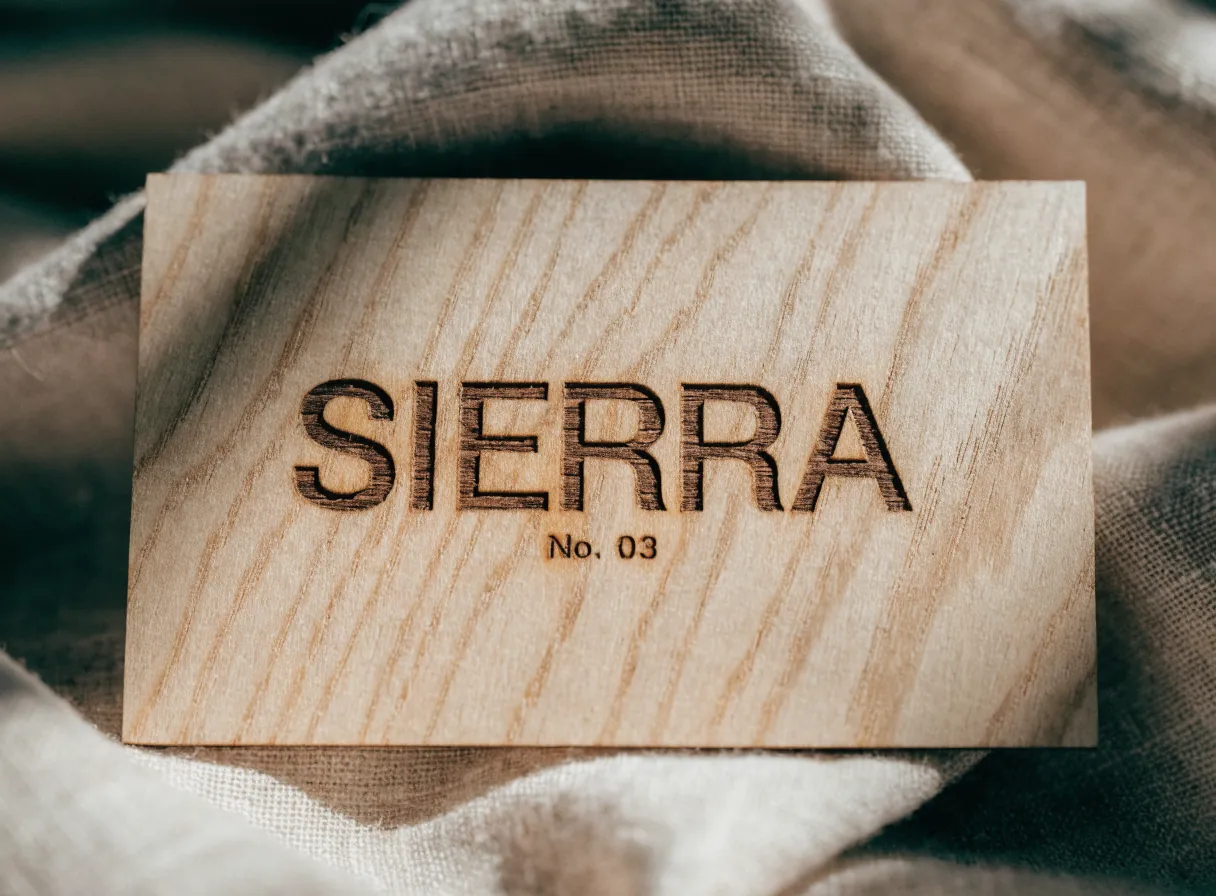
Name the species and ask for quartersawn wood for straight grain, or flatsawn for the wide cathedral figure. Ask for the test grid made with the board from your order and already oiled, arrange the artwork so the fine strokes run with the grain, and ask for the edges sanded before sealing. Decide from the start between grain selected piece by piece and grain taken as it comes.
The grain is the signature of the tree. The laser reads it without asking permission, and anyone who designs for wood works with that signature from the first stroke.
Questions that come up often
Why does the same design come out different on two wooden boards?
The recipe goes out identical, same file and same parameters, and the whole difference lives in the wood. The beam burns until the fiber goes off as smoke, and the depth of the groove follows the density that sat underneath. In the Atelier's bank, of the 58 records where the technique is laser engraving and the material is wood, 18 name the grain as the failure point.
How do I keep the letters from coming out streaked or uneven in weight?
The orientation of the artwork decides. A line parallel to the grain stays inside a single band and comes out even from end to end. Turn it ninety degrees and it crosses band after band, and a long name set horizontally over vertical grain crosses them across every one of its letters, with a different width at every crossing. Turning the artwork is often enough.
What is the brown mark around the engraving, and can sanding take it off?
It is the halo, heat that was left over. When power rises to beat a hard band, the excess travels along the fiber and toasts the wood around the groove, and that brown halo went into the pore and sits past the reach of sanding. The craft controls it by lowering power and running several passes, with air assist that pushes flame and smoke, and by masking the face with film or tape.
Which wood do I ask for when the design carries very fine detail?
For fine detail you ask for diffuse porous wood, such as maple, birch and linden, which spread the pores across the whole ring and give even density over the whole face. Ring porous woods, such as ash, oak and encino, pack the large pores at the start of every ring and draw the grain strongly. Walnut sits in the middle. This classification is craft knowledge.
Why am I asked for a test before the whole order is engraved?
Every batch burns differently, by species, by moisture and by the sealer it arrived with. So a test grid of power and speed runs on an offcut of the same board, and the recipe for the run comes out of that. The grid is judged already oiled, because the oil soaks deeper into the engraved zone and darkens the pattern as it seals.
Follow the thread
Three doors to carry the journey forward.

Have you imagined yours yet?
Tell us what you imagine and who it is for. We listen first, and from there we create it with you until you hold it in your hands.