The record that teaches a model to build the route
A corporate piece passes through several workshops before it exists. We wrote 1,291 records against one schema so a system lays out that whole route, names the step that governs the calendar and marks the point where the decision returns to a pair of human eyes.
A record is the structured entry for one piece. In the Atelier's bank, 1,291 pieces carry the same record, with material, technique, critical capability, the route in ordered steps and the workshop for each step. With that data, a system lays out the full route of an order, names the step that governs the calendar and marks where a person decides.
When you commission a corporate kit, you start with the list of pieces. The question that decides the outcome sits one floor below. How many hands the order passes through before it arrives complete on a single table. A model answers that well when the data comes written with structure. My work is to build that data so the answer comes out on its own, and to mark the point where the decision returns to a pair of human eyes.
The record and a closed vocabulary
We wrote the record for 1,291 pieces over 1,184 photographs, and all 1,291 carry the same record. Of those, 979 come filled to the last field, and the most common gap is the brand, empty in 282 because some pieces carry none at all. Among those fields go the material, the technique, the critical capability, the route in ordered steps with the workshop for each step and the point where the piece breaks.
The workshop field runs against the Atelier's closed vocabulary. The whole bank uses forty-eight distinct values, and one of them, materials supplier, describes supply, which leaves forty-seven workshops. With that vocabulary, two routes compare line by line and a count by workshop comes out of an exact query.
The critical capability field runs in free prose and reaches 1,126 distinct wordings, with twenty-seven records left blank. Workshops group by exact match and capabilities group by pattern match, and every number in this entry declares which of the two definitions I used.

What the system lays out on its own
Of the 1,291 pieces, 1,202 call for two or more workshops. Of those, 875 call for three or more. The route runs five steps on average, 5.14 measured across the 1,264 written routes, with a median of five. The high mark of the bank reaches nine workshops and eleven ordered steps, and it lives in a single record.
That table shows what the word chain means. The tote and the plain tee come out of flat screen printing. The all-over-print garment starts as sublimated fabric and gets sewn afterward, with the artwork matched at the shoulder seam. The caps go to the embroidery machine, the pen and the pins to pad printing for a tiny area on a curved surface, the tumbler to rotary laser engraving and the mug to a ceramic decal with a kiln. Step eleven concentrates the cross-tone control across the nine processes.
Those eleven steps come out of the route field already ordered, and the system returns them as an unfolded plan. Before the record existed, that same answer depended on the memory of someone who had coordinated a table like it.
The step that governs the calendar
Every route has one step that rules the others. We call it the critical capability, the process that is scarcest, slowest or hardest to repeat, and it pays to identify it while the order is still on paper.
Against the full bank, by pattern match on the critical capability field, foil and hot stamping appear in 173 records. Records whose critical capability names case wrapping or the rigid box come to seventy-seven. Embroidery appears in seventy.
The reason for first place is physical. Foil is a leaf transferred by heat and pressure from an engraved die made for each design. The trade works it on coated paper in a range of 120 to 160 degrees Celsius, and it climbs to the high end when the substrate is fabric. On dyed linen, that temperature opens the edge of the letter as soon as the weave runs coarse.
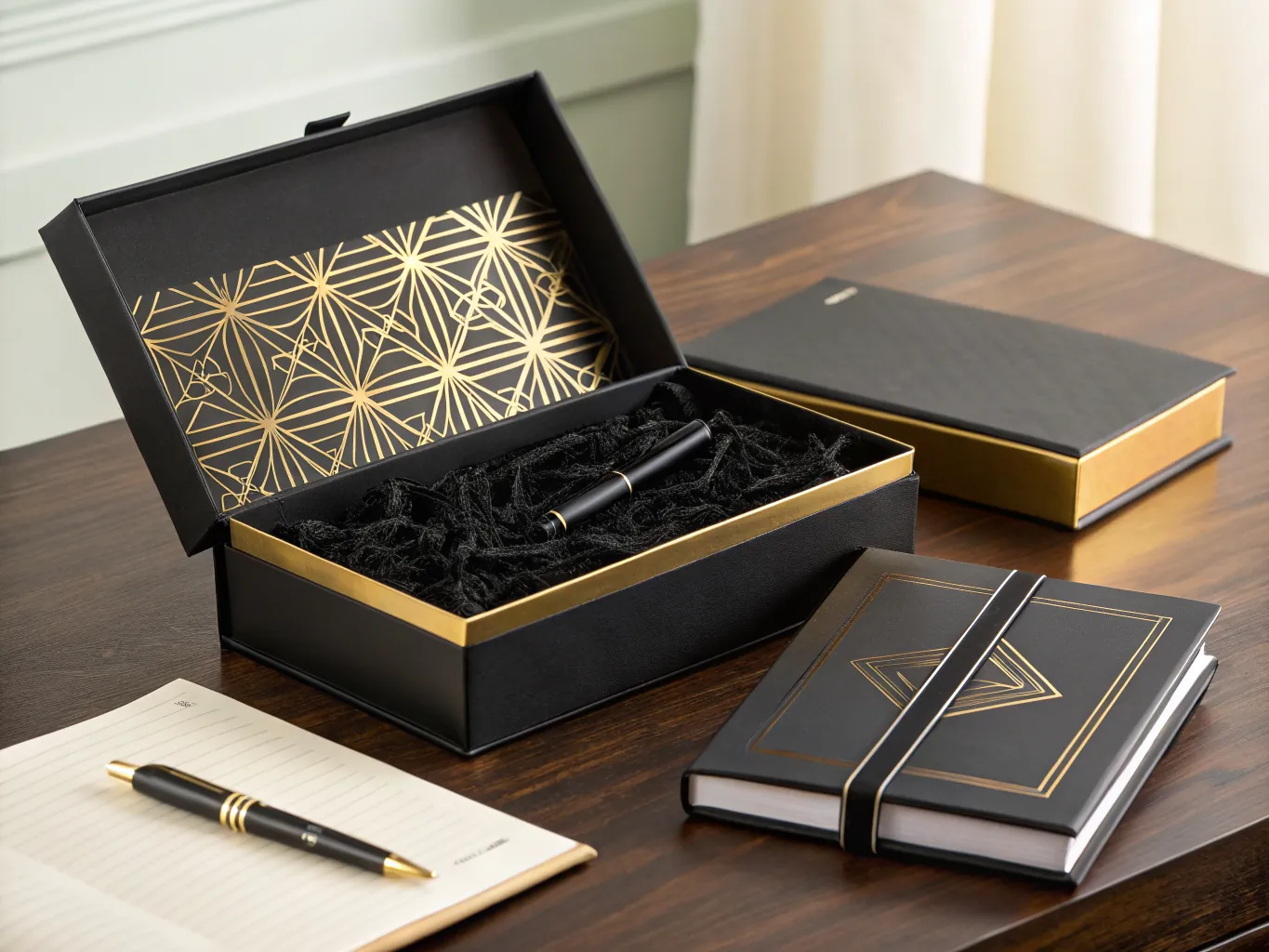
The executive kit in the photograph runs through seven workshops, and its critical capability lives in the hand wrapping of the rigid box, with a clean corner and the foil registered against the edge. Gold appears there in four forms, the pattern on the lid, the tape on the edge of the tray, the edge of the book and the rings on the pen. The metallics read the same as one another because all of them start from the same leaf or the same plating bath. A pigment mixes again with the chemistry of every process, and that is where the real work begins.

Where the system hands over the decision
This table setting runs through seven workshops and crosses three color systems inside one place setting. The menu card carries offset in two spot inks on cotton paper, the napkin carries embroidery thread on linen and the glass carries kiln-fired ceramic ink on curved glass. The embroidered leaf lifts sheen with the twist of the thread and takes a deeper tone than the printed one, and the leaf on the glass picks up the wine behind it.
This is where the work of a model ends, and the reason is optical. A screen emits its own calibrated light. A piece returns the light of the room where someone opens it. The graphic trade fixes that reference light at 5,000 kelvin to compare samples, and even then two tones that match under that source separate under another. The phenomenon is called metamerism, and a kiln-fired glaze also falls outside the color space of a common monitor.
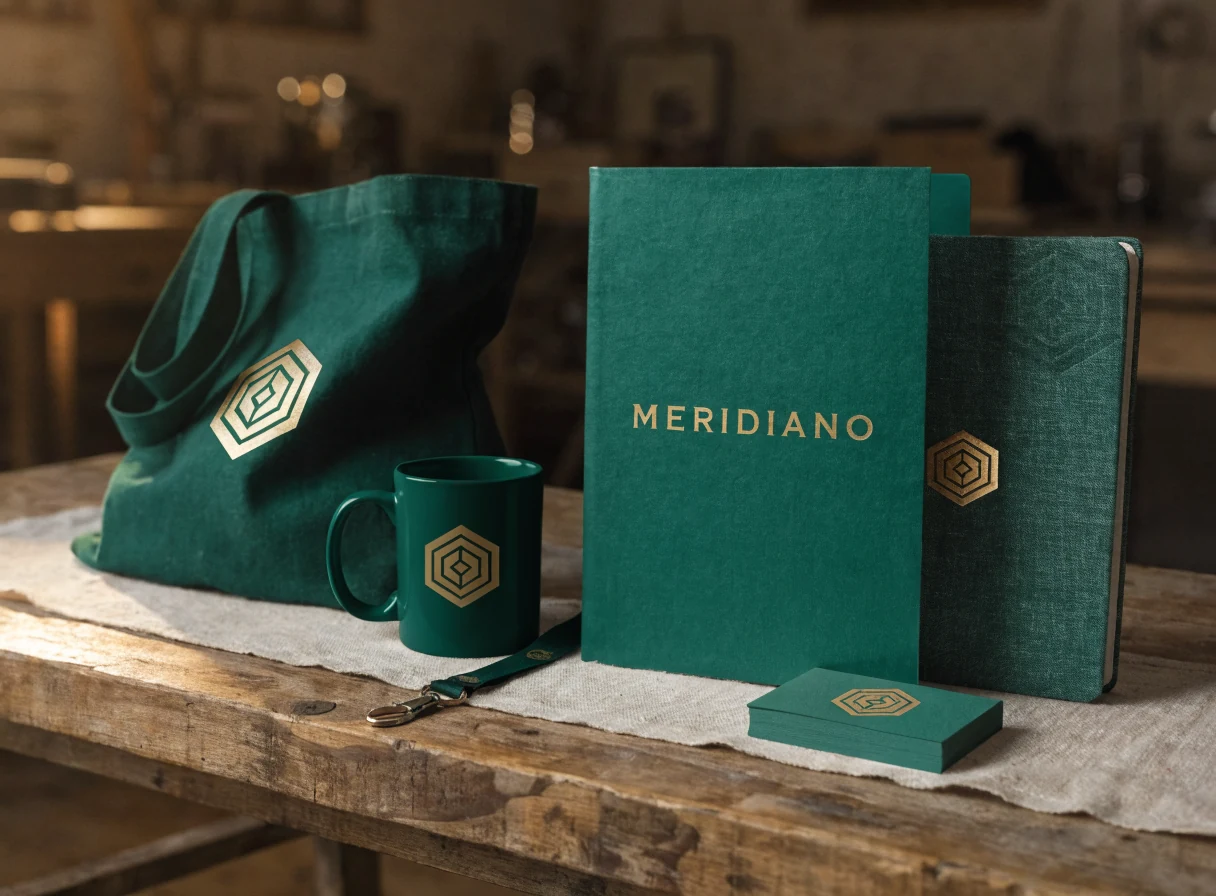
The green set that opens this entry takes the problem one degree further. Its record declares six substrates spread across six workshops, cotton canvas, glazed ceramic, wrapped board, bookcloth, card stock and woven tape. The green of the mug is a glaze that defines itself inside the kiln, with a decal that passes through a firing between 780 and 820 degrees and delivers its color on the way out. The green of the tote is vat-dyed fiber, and the green of the cards comes dyed through the body of the board. Three chemistries and one single color number on the order.
The system builds that route, names the six substrates, flags tone reconciliation as the main risk and orders the samples to request before production is released. Approval closes with the pieces together on the same table, under one light. You approve what you hold in your hand, and that approval becomes the standard every workshop is measured against. The person is there because their judgment is worth more than the judgment of the system at that point.
The field that predicts the failure
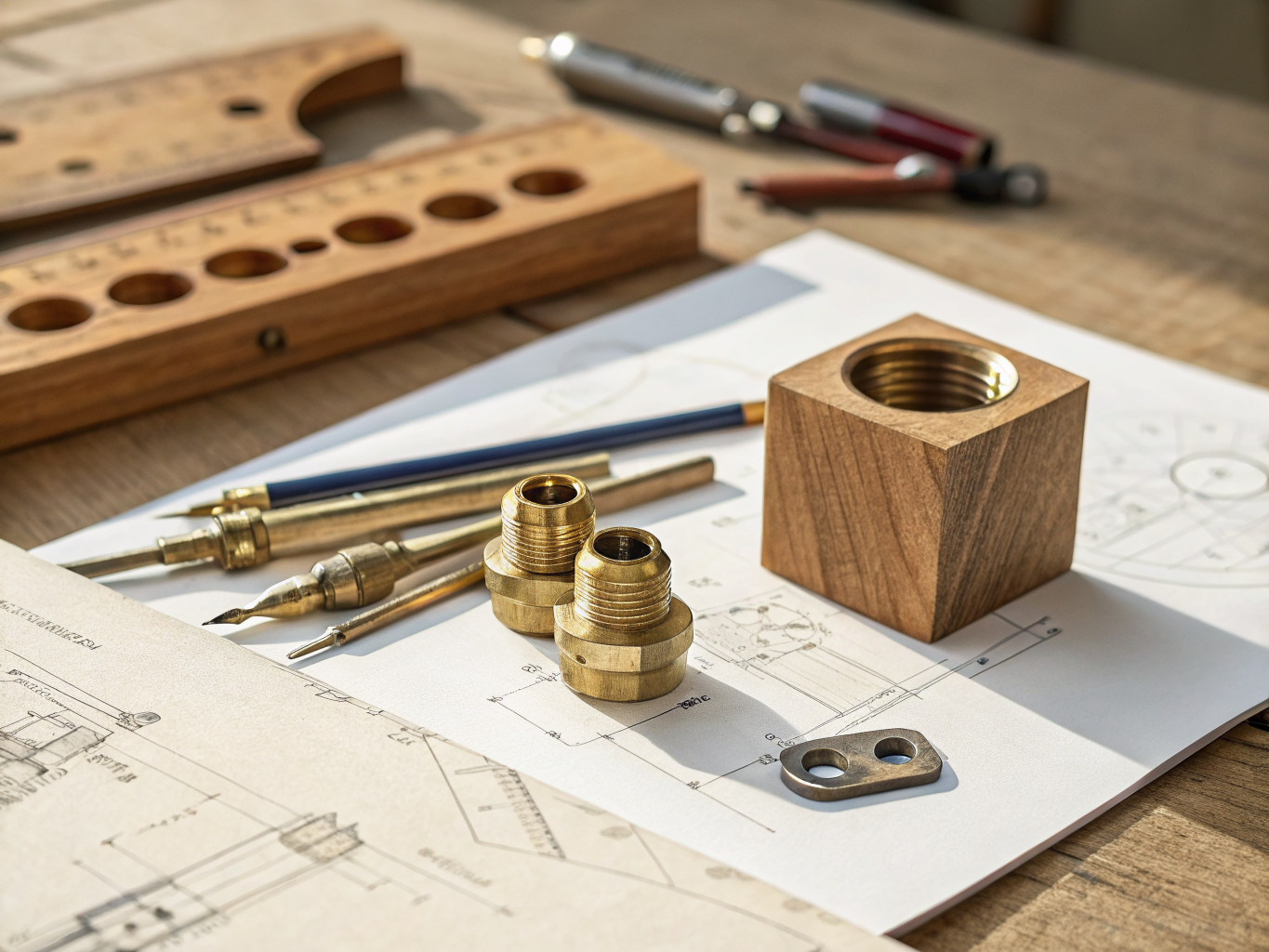
Every record also declares where the piece breaks, and this prototype of three workshops and five steps shows it clean. The plan arrives with the tolerances undeclared, the machinist assumes their own and the bushing sits loose in the wood housing. Hardwood then moves with humidity, on the order of one percent of its width between dry season and wet, so a fit that was correct on the lathe table drifts once the piece changes city.
The system reads that field and returns the warning while the piece is still a file. A plan with the critical dimension written, the tolerance declared and the final substrate named turns three workshops into one language.
Three questions for your next order
How many workshops my piece touches and in what order they run. Which of those steps is the critical capability of the route. When I hold the color sample on the final substrate in my hand.
The system answers the first two with the route unfolded. The third gets answered with a table, an even light and a person who says yes.
Questions that come up often
How does a system know how many workshops my order passes through?
Every record names the workshop for each step against the Atelier's closed vocabulary. The whole bank uses forty-eight distinct values, and one of them, materials supplier, describes supply, which leaves forty-seven workshops. With that vocabulary two routes compare line by line and the count by workshop comes out of an exact query.
Why does the color look different on each material of the same kit?
Because each material returns light in its own way. A screen emits its own calibrated light, and a piece returns the light of the room where someone opens it. The graphic trade fixes that reference light at 5,000 kelvin to compare samples, and even then two tones that match under that source separate under another. The phenomenon is called metamerism.
Follow the thread
Three doors to continue the journey.
Have you imagined yours yet?
Tell us what you imagine and who it is for. We listen first, and from there we create it with you until you hold it in your hands.