Spot UV varnish, gloss as the only ink
The same card goes quiet under ceiling light and lights up under a band of sun. That behavior has a physical explanation, and out of it come the decisions about stock, weight, stroke width and inspection that make a registered varnish look the way you imagined it.
Spot UV varnish covers registered zones of the artwork and lets light do the work of ink. It sends the reflection back along a single direction, so the letter fires when your eye lands in the bounce and it sinks in tone under diffuse light. On a dark substrate it lives in two states, mirror and depth, and the paper and the stroke width decide which one rules.
The same card reads two ways
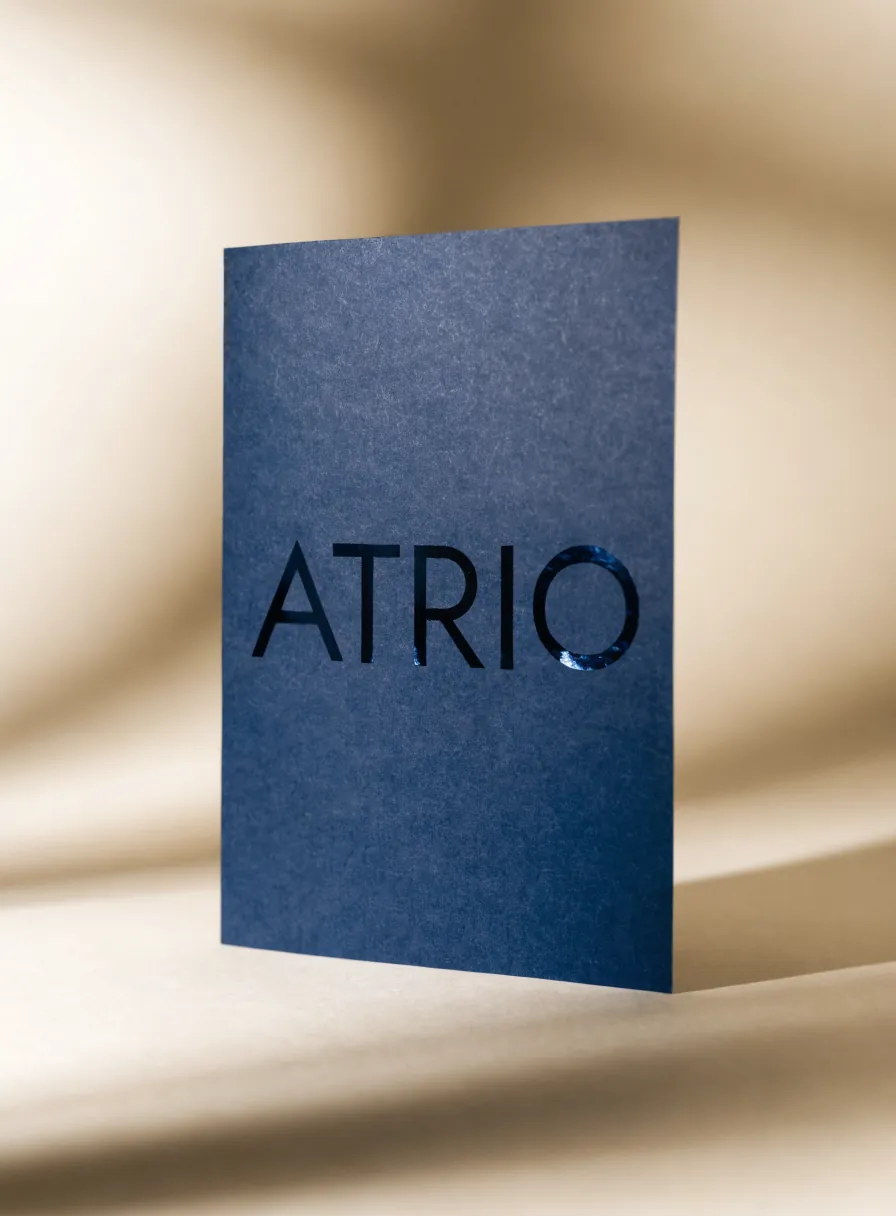
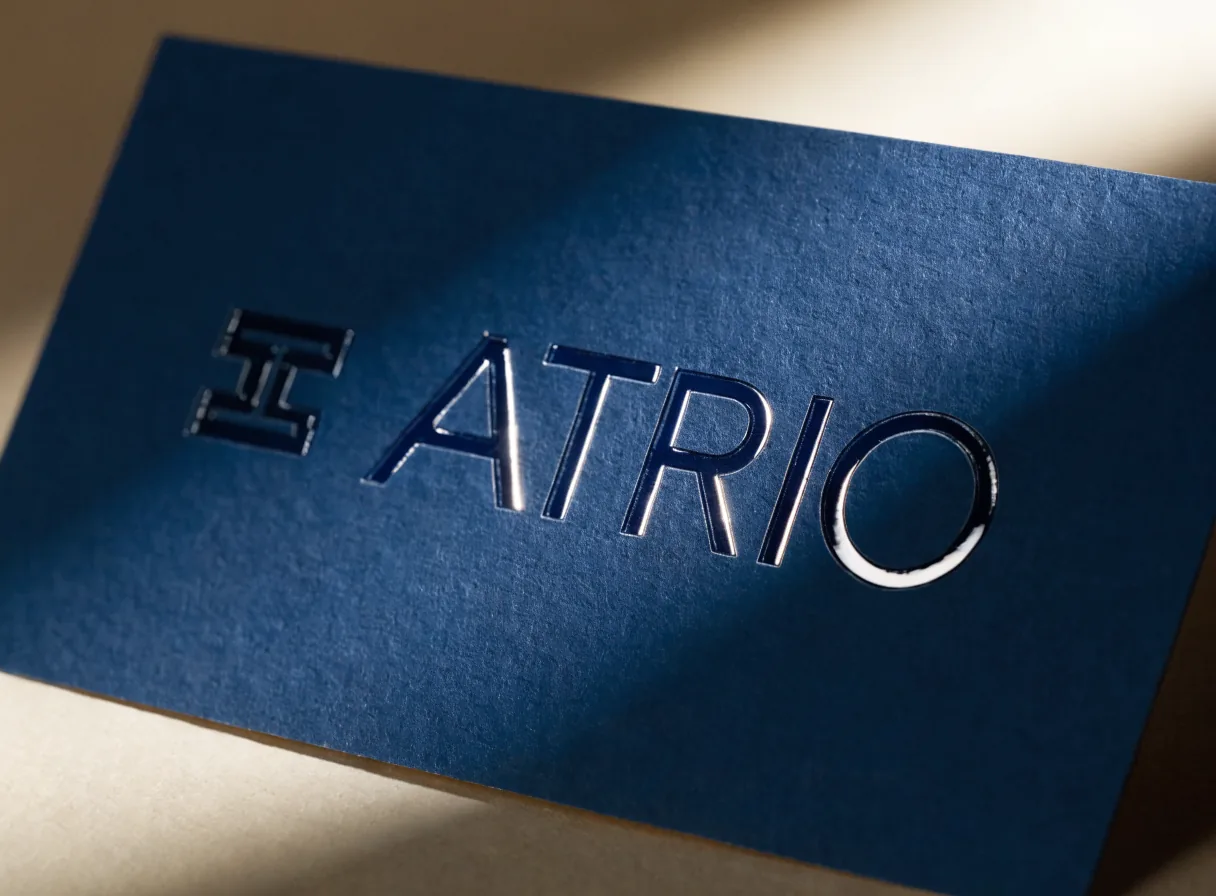
The first photograph holds a folded card in navy cardstock, standing, with diffuse light coming straight at it. The word ATRIO sits one tone darker than the paper, a dense wet blue, and you can pass it by without registering that there is a finish there. In the second, the same cardstock turned until a band of light crosses the face. The word fires, it returns an almost metallic white, and the monogram on the left, which fell outside the band, stays dark.
Both readings are correct and both belong to the same piece. Understanding where that difference comes from lets you decide whether spot UV varnish carries what you have in your head.
Gloss works by angle
A gloss varnish returns the image of the source that lights it. The matte paper around it scatters that same light in every direction, which is why it looks even from any position. The varnish sends it back along a single direction, so it fires when your eye lands in the bounce.
That is where the behavior that surprises you the first time comes from. Under an overcast sky or a large ceiling panel, the source the varnish manages to return is a huge grey surface, and the varnished letter ends up reading darker than the cardstock. The varnish also seals the fiber and takes away the paper's soft bounce, so the treated zone sinks in tone. On a dark substrate it lives in two states, mirror when it catches a point source and depth when it loses it.
The design decision is where the piece is going to live. A card travels hand to hand, it turns, it finds the source on its own and flashes several times a minute. A folder lying flat under diffuse light finds it rarely, and there it pays to raise the varnish load and add relief so the finish works by touch as well.
The paper decides whether there is a mirror
The mirror exists when the varnish stays on top. On a through-dyed cardstock with open fiber, visible in the navy of the photographs, the varnish drinks inward, cures already sunken and dries matte. The result is a patchy gloss, with live zones and dead zones inside the same letter.
The record for this card puts it in these words inside its where it breaks field, it almost always calls for double application or a sealer first. Both ways cost one more pass on press and both are ordered from the artwork stage, with the sheet still held.
Weight comes in through another door. A heavy varnish load shrinks as it cures and pulls the sheet, so the paper needs body to hold itself flat. What follows comes from the trade. On through-dyed cardstock the healthy range runs from 300 to 400 grams, or two sheets duplexed when you want a thick edge. On through-dyed board with fine texture it climbs from 350 to 600 grams. The card format runs at 85 by 55 millimeters, also by trade custom, and at that size the sheet runs many up, so one shift ruins the whole sheet.
The matte field makes the gloss legible
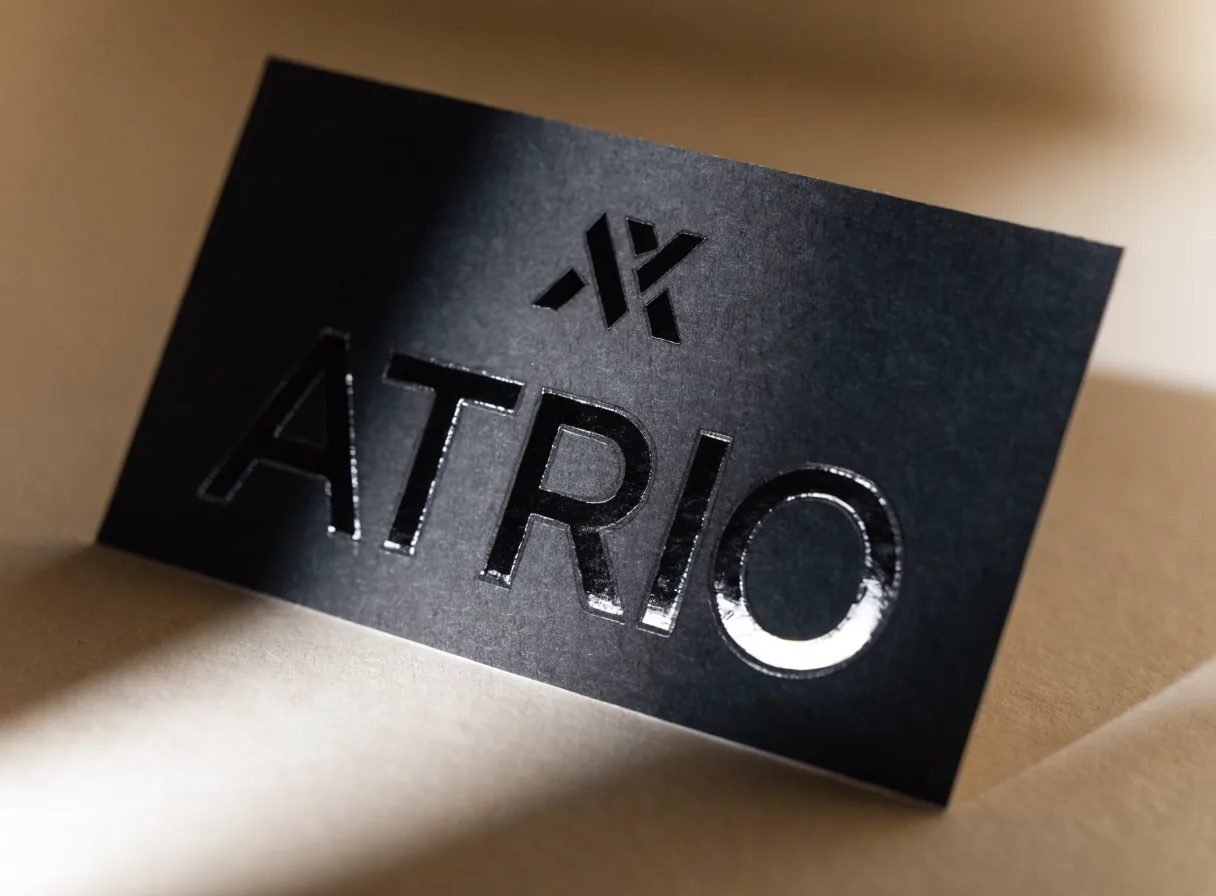
On the black card the varnish barely separates from the paper in color. The reading happens through the difference in surface between the matte black and the patent leather shine, which is why the matte lamination underneath counts as part of the finish.
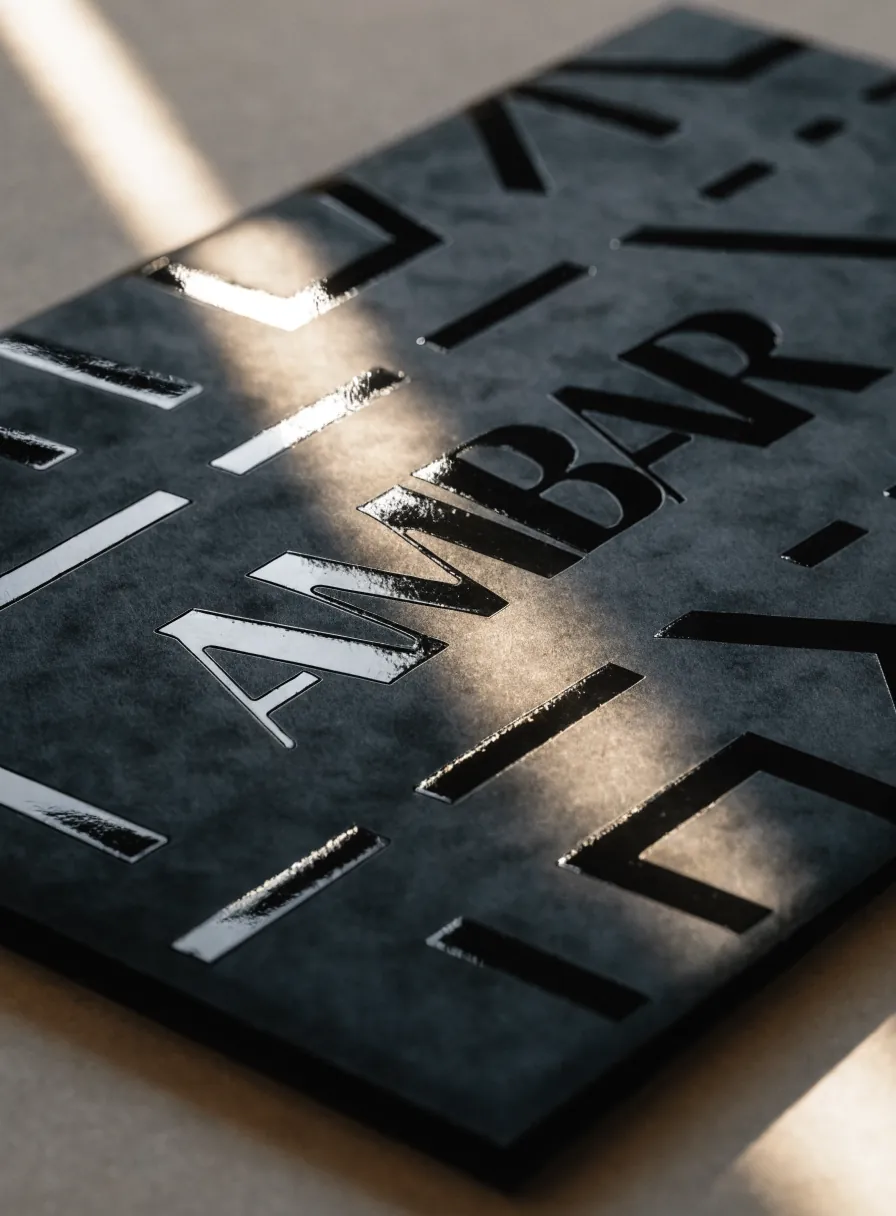
Soft touch lamination opens a front of its own. It is a surface engineered to repel, so UV varnish laid over it can end up with no anchor, it lifts with a fingernail, and the defect shows up with the box already open on the desk. In the piece bank of El Cuaderno del Atelier, five records name it inside their where it breaks field. Soft touch film prepared to receive varnish does exist, and it pays to ask for it by name and confirm compatibility before the roll is bought. The AMBAR piece in the fourth photograph shows the limit, because its thick strokes hold a continuous mirror and inside some of them you can still read the mottling of the substrate.
How much line holds a mirror
The monogram on the navy card has fine bars and it does carry varnish, you can tell because they read darker and wetter than the paper. They stay dark all the same. A thin line holds the film and needs width to return the full image of the source, so it delivers only an edge of light.
Out of that comes a design rule that saves disappointment. Typographic mass is what fires, and the O of ATRIO proves it across the three card shots that carry that mark, because it returns the whole window. Hairlines, keylines and contact details are best resolved in ink or in deboss, leaving the varnish for the name.
Tenths of a millimeter
Registration is what holds up the impression of value. Varnish that runs a few tenths of a millimeter off leaves a bright halo outside the letter, and on black that halo is visible from across the table. That tolerance sits with the trade, and the bank confirms the matter is general, because 71 records name registration in their where it breaks field and 68 name the fingerprint.
On matte black every defect turns visible. A speck of dust trapped under the varnish stays encapsulated and reads as a crater. A greasy fingerprint marks on contact, and the piece is handled with gloves from the moment it leaves the lamp. The inspection that fits is under raking light, piece by piece, before boxing, because the defect of a specular finish appears under the light that makes it specular. Nine records in the bank ask for that inspection in their where it breaks field and twelve order it as a route step.
What to settle before the sheet runs
The route for the navy card orders four steps, each one under a different workshop label, and the workshop count field on that same record marks three. The version that goes in with matte soft touch lamination orders six steps. In the piece bank of El Cuaderno del Atelier, 1202 of 1291 records call for two or more separate suppliers, and 1256 touch two or more workshop types, 70 routes pass through the varnishing and lamination workshop, and 11 records name UV varnish or spot UV inside their technique, nine of them with three workshops declared. The cardstock arrives from one place, the varnish from another, the cutting from a third, and a defect from any of them shows up in the same letter.
The decisions that count are taken early. If the substrate runs unlaminated, the double application or the sealer is settled now. If it runs laminated, the soft touch rated for varnish is confirmed in writing. The weight goes up when the load runs heavy, the fine rules come out of the artwork, and the raking light inspection is agreed. With that resolved, gloss alone carries a name, with no drop of ink on top.
Questions that come up often
Why does my UV varnish look dull and even darker than the paper?
A gloss varnish returns the image of the source that lights it. Under an overcast sky or a large ceiling panel that source is a huge grey surface, so the varnished letter reads darker than the cardstock. The varnish also seals the fiber and takes away the paper's soft bounce, and the treated zone sinks in tone. Give it a band of raking light and it fires.
What paper and what weight hold gloss varnish without going patchy?
The mirror exists when the varnish stays on top. On a through-dyed cardstock with open fiber the varnish drinks inward, cures already sunken and dries matte, and the letter ends up with live zones and dead zones. The way out is double application or a sealer first, ordered from the artwork stage. By trade custom the healthy range runs from 300 to 400 grams on through-dyed cardstock, and from 350 to 600 grams on board with fine texture.
Does gloss varnish hold over soft touch lamination?
Soft touch lamination is a surface engineered to repel, so UV varnish over it can end up with no anchor and lift with a fingernail, with the box already open on the desk. Soft touch film prepared to receive varnish does exist, and it pays to ask for it by name and confirm compatibility before the roll is bought. In the piece bank of El Cuaderno del Atelier, five records name it inside their where it breaks field.
Why do thin letters shine less than thick ones?
A thin line holds the varnish film and needs width to return the full image of the source, so it delivers only an edge of light. Typographic mass is what fires. Hairlines, keylines and contact details are best resolved in ink or in deboss, leaving the varnish for the name.
How do you inspect varnished pieces to confirm they came out right?
The inspection that fits is under raking light, piece by piece, before boxing, because the defect of a specular finish appears under the light that makes it specular. On matte black a speck of dust under the varnish stays encapsulated and reads as a crater, and a greasy fingerprint marks on contact, so the piece is handled with gloves from the moment it leaves the lamp.
Follow the thread
Three doors to carry the journey forward.

Have you imagined yours yet?
Tell us what you imagine and who it is for. We listen first, and from there we create it with you until you hold it in your hands.