Two ways to put a name on a crystal glass
Positive sandblasting opens the letter to the abrasive and reserve sandblasting opens everything around it. Each one calls for a mask cut the inverse of the other, and the geometry of the glass decides which of the two holds all the way around the body.
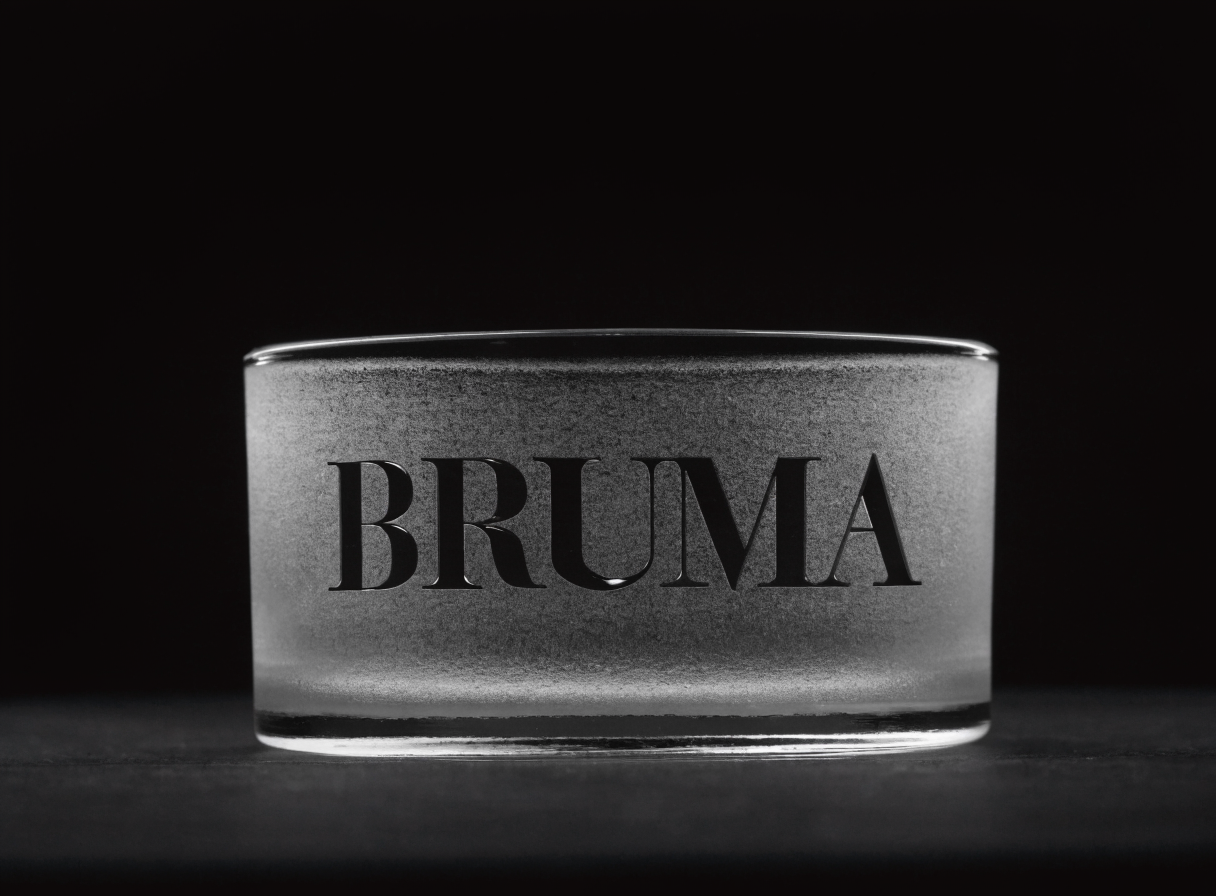
A name lands on a crystal glass in two ways, positive sandblasting and reserve sandblasting. In positive the sand bites the letter and the name comes out frosted over clean crystal. In reserve the sand bites the field around it and the letter stays polished inside a matte veil. The same blast cabinet does both, and each one calls for a mask cut the inverse of the other.
A name can land on a glass in two ways, and the two read differently from across the table. In the first, the sand bites the letter and the name comes out frosted over clean crystal. In the second, the sand bites the whole field around the letter and the name stays polished and transparent, lit up inside a matte veil. Both are called sandblasting, both come out of the same cabinet, and each one calls for a mask cut the inverse of the other.
The distance between the two shows up clearly in the Atelier's piece bank. Sixty four records name arenado or sandblast in their technique field, forty two of those work on crystal or glass, and four declare reserve or negative. Opening a letter to the abrasive is ordinary trade work in any mid sized city in the country. Leaving the whole field even with the letter intact appears four times across the entire bank, and that scarcity is worth understanding before you choose. The pieces in the photographs carry the name BRUMA.
The mask is cut in reverse
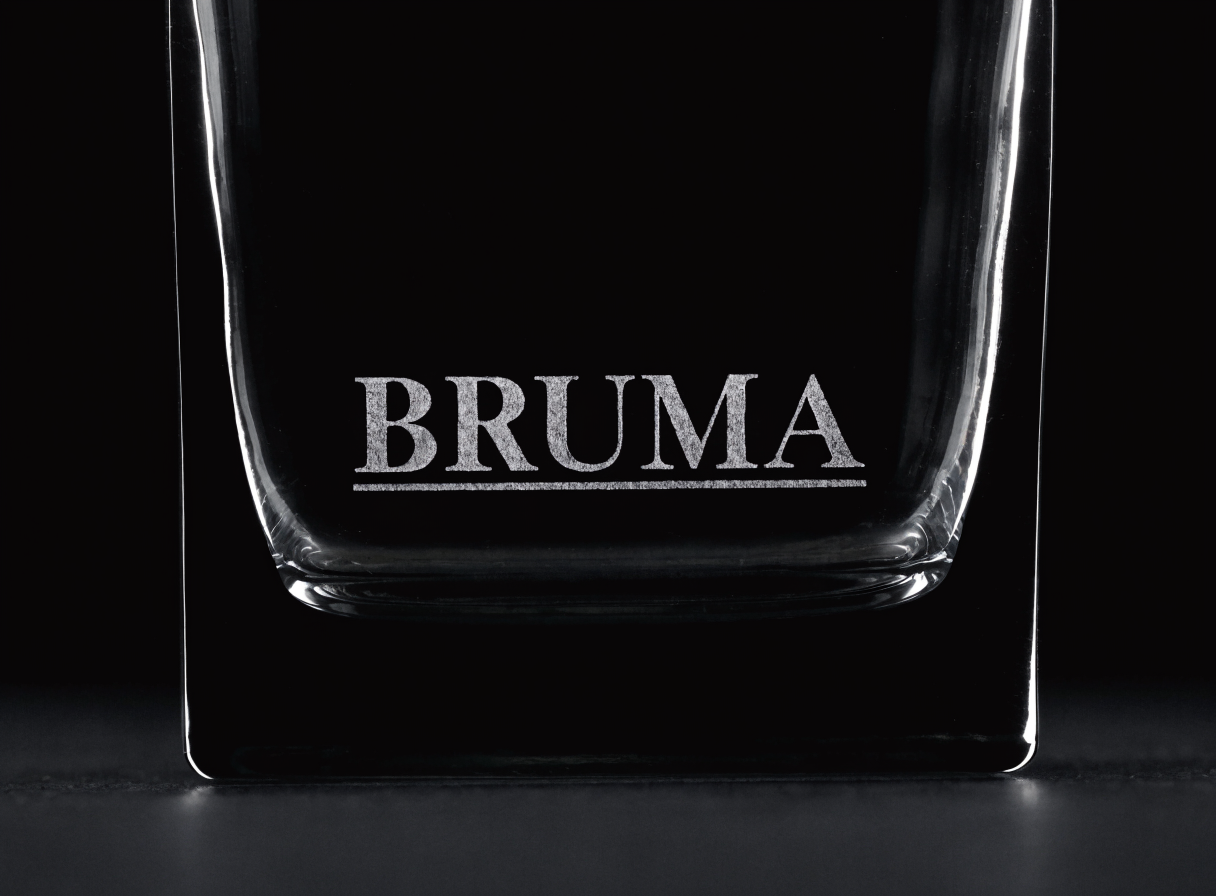
In positive sandblasting the whole glass is covered in vinyl, the outline of the letter is cut, and the letter is lifted away. What remains is a name shaped opening with the rest of the body protected. The sand enters through that opening. Step 2 of the route for the square glass in the second photograph puts it in those terms. The logotype is cut in positive and weeded by hand.
In reserve sandblasting the cut follows the same drawing and the weeding runs the opposite way. The whole field lifts away and only the letter stays down. The route for the low glass in the first photograph says it in these words at step 2. The typography is protected and the rest of the body is opened. That is the exact point where the two techniques stop resembling each other.
The islands inside the name
BRUMA has five letters. The B carries two closed counters, the R carries one and the A carries one, so the typography holds four counterforms. In positive sandblasting those four counterforms sit loose in the middle of the opening, held by their own adhesive alone, and the cabinet attacks them at the edge. When one lifts, that letter comes out filled with sand and the glass goes to scrap. The record for the square glass puts that failure first in its breakage field and places uneven sandblasting second, in those words.
Reserve sandblasting inverts the problem and enlarges it. There the counterforms stay open and get blasted along with the rest of the field, and what holds by its own adhesive is the complete letter. Five islands, each one standing alone on the glass, with the spacing between them entrusted to the transfer tape that carried them from paper to glass. A mask that lifts or peels appears in the breakage field of thirteen sandblasting records in the bank, and the one for the low glass writes it precisely. The mask lifts on the curve, bleeds sand into the letter, and eats the fine terminals of the serif.
There is a way out for names with small letters and many counterforms. The masking layer is printed. The route for the tall glass in the last photograph carries it at step 2, handled by a flat screen printing workshop. A masking enamel is produced with the letter in reserve. A continuous film arrives whole, with no islands to peel and no tape to align. Preparing the screen adds a step to the artwork, and it earns its place when the typography is delicate.
A wall to wall veil is judged whole
Marking a small letter forgives a great deal, because the eye goes to the letter and leaves the glass around it in peace. A wall to wall blasted field changes the rules, because the finish becomes the entire surface. The record for the low glass names that capability plainly, an even veil over a curved wall, clear of clouding and clear of pass banding.
That is why the large field runs at low pressure and with crossed passes, exactly as step 4 of that same route writes it. Low pressure because sand at high pressure pits the glass, and pitted glass reads a dirty grey. Crossed passes because a single direction leaves stripes the width of the nozzle fan, and a second direction across them averages those stripes until the veil runs even from wall to wall. Two directions, and that is the arithmetic of the trade.

The turntable closes the wrap
A band that wraps a cylindrical body carries a problem a standalone letter never meets. The band closes on itself. Where the first pass meets the last there is an overlap, and the bank describes it in a single record, the stemmed glass with a band in negative. The overlap of the band shows up as a darker line. That same record names the remedy in its critical capability field, and it is the only one in the whole bank that names it, sandblasting on a turntable for a continuous band on a curved body.
The turntable takes the beginning and the end away from the band. The glass mounts on a plate that turns at constant speed while the nozzle holds still or advances slowly on the vertical. The gun receives a body passing in front of it. The distance becomes constant by geometry and the band closes even.
The curve decides which of the two fits
Vinyl is a flat sheet. A straight cylinder takes the wrap without a wrinkle, because a cylinder unrolls onto a plane. The bowl of a balloon glass is a double curvature, and a flat sheet lays onto it only in pieces. There the mask is cut into narrow gores, given relief cuts, or replaced by a masking layer that stretches.
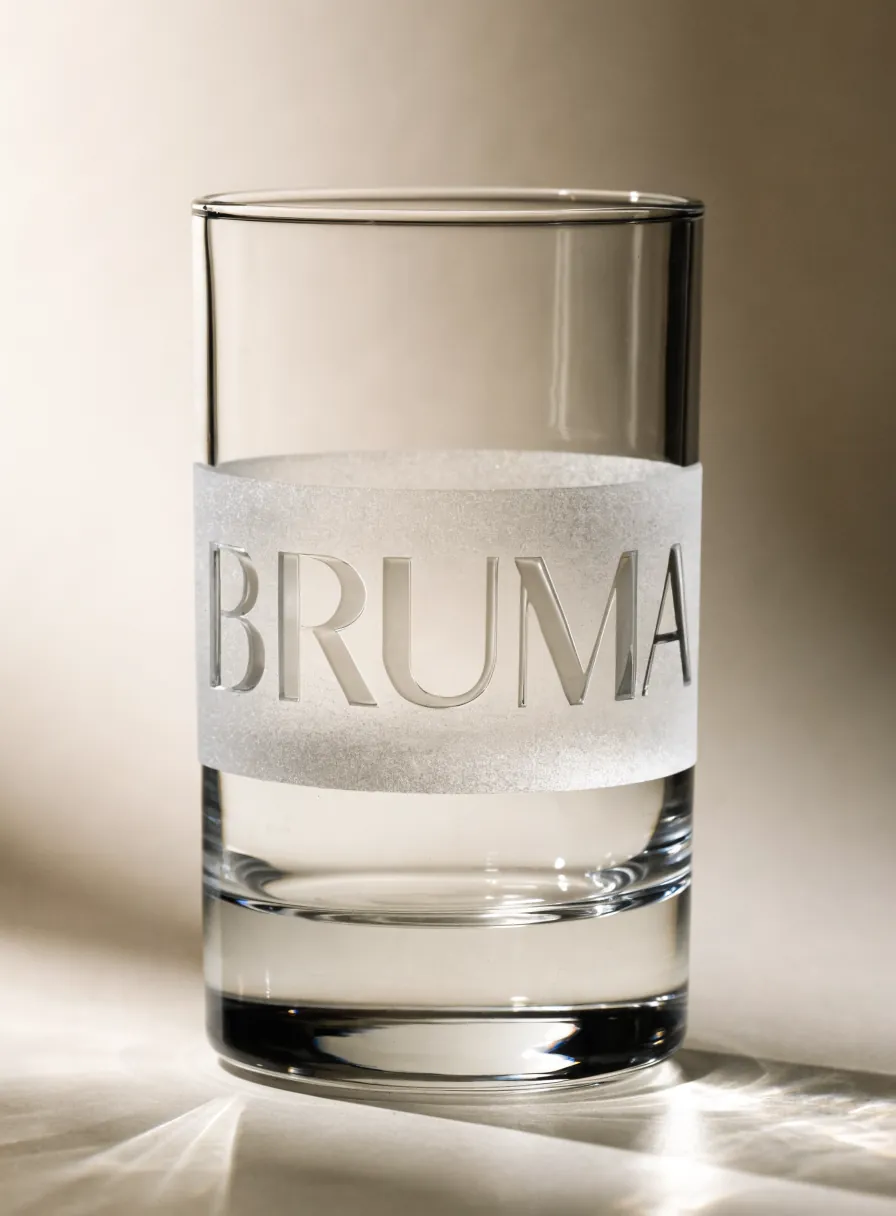
The stemmed glass in the third photograph works in reserve, and its route spells it out at step 3. Mounting of the mask over curved and doubly curved surface, with the band blasted at low and even pressure. The mark lives on the widest part of the bowl and the letter is small. Every one of those decisions is the double curvature speaking.
The tall glass in the last photograph shows the other consequence of the wrap. The name follows the turn of the wall and the final letter slips over the edge of the body. When the name has to read in one glance, measure the developed circumference of the body at the height of the band and compose the artwork on that measurement. The apparent width in a catalogue photograph misleads you as soon as the body turns.
Two lights before the mask comes off
The workshop inspects with the mask still on. Nine sandblasting routes in the bank name inspection against the light or through the light, and the four pieces in this article sit among those nine. With the glass held between the eye and the lamp, clouding and pass banding come forward, because an uneven veil changes how much light passes through.
The trade adds a second light that the records leave unwritten. At a raking angle, with the lamp nearly parallel to the wall, the relief comes forward, and with the relief comes the sand that crept under the edge of the mask. Two lights, and the second one is workshop custom.
Both inspections come before the vinyl is removed for a practical reason. With the mask on, a weak area gets blasted again in the same registration. Once the mask is off, the registration is gone and the glass is replaced.
How to ask for it
The route for the glass in positive has four steps and touches three separate workshops, the vinyl cutting, the blast cabinet and the packing. The route for the wall to wall reserve glass has six steps and touches five separate workshops, because it adds the blank glass and a final finishing station. What those extra steps add is control.
With a small letter, a thin rule or many counterforms, positive treats the piece better. With short names, thick stems, and the intention that the glass light up when someone raises it against the light, reserve is the road, and a cylindrical body serves you well so the turntable can do its work.
Both ways age well, because sandblasting opens the glass and stays inside it. What you choose is where the risk lives, in the four counterforms of positive or in the whole veil of reserve.
Questions that come up often
What is the difference between positive sandblasting and reserve sandblasting?
Positive sandblasting lifts the letter out of the vinyl mask and leaves the rest of the glass covered, so the sand enters only through the opening of the name and the letter comes out frosted. Reserve sandblasting lifts the whole field and leaves only the letter down, so the name stays polished and transparent inside a matte veil.
What happens with letters that have openings inside them, like the B or the A?
Those openings are called counterforms, and they remain as vinyl islands held by their own adhesive. In positive sandblasting the cabinet attacks them at the edge, and when one lifts, the letter comes out filled with sand and the glass goes to scrap. The name BRUMA carries four counterforms, two in the B, one in the R and one in the A.
Which of the two suits the name I want to put on?
With a small letter, a thin rule or many counterforms, positive sandblasting treats the piece better. With short names, thick stems, and the intention that the glass light up when someone raises it against the light, reserve is the road, and a cylindrical body serves you well so the rotating plate can do its work. Both age well.
How does a matte band travel all the way around a glass with its starting point hidden?
A band that wraps a cylindrical body closes on itself, and the overlap shows up as a darker line. The remedy the Atelier's piece bank names is sandblasting on a turntable for a continuous band on a curved body. The glass turns on a plate at constant speed in front of a still nozzle, the distance becomes constant by geometry and the band closes even.
Can a round bowl glass be sandblasted the same way as a straight glass?
Vinyl is a flat sheet. A straight cylinder takes the wrap without a wrinkle, because a cylinder unrolls onto a plane. The bowl of a balloon glass is a double curvature and a flat sheet lays onto it only in pieces, so the mask is cut into narrow gores, given relief cuts, or replaced by a masking layer that stretches.
Follow the thread
Three doors to carry the journey forward.

Have you imagined yours yet?
Tell us what you imagine and who it is for. We listen first, and from there we create it with you until you hold it in your hands.